
Benin Dues. Dealing with Looted Royal Treasures
24 August 2024 to 8 March 2026
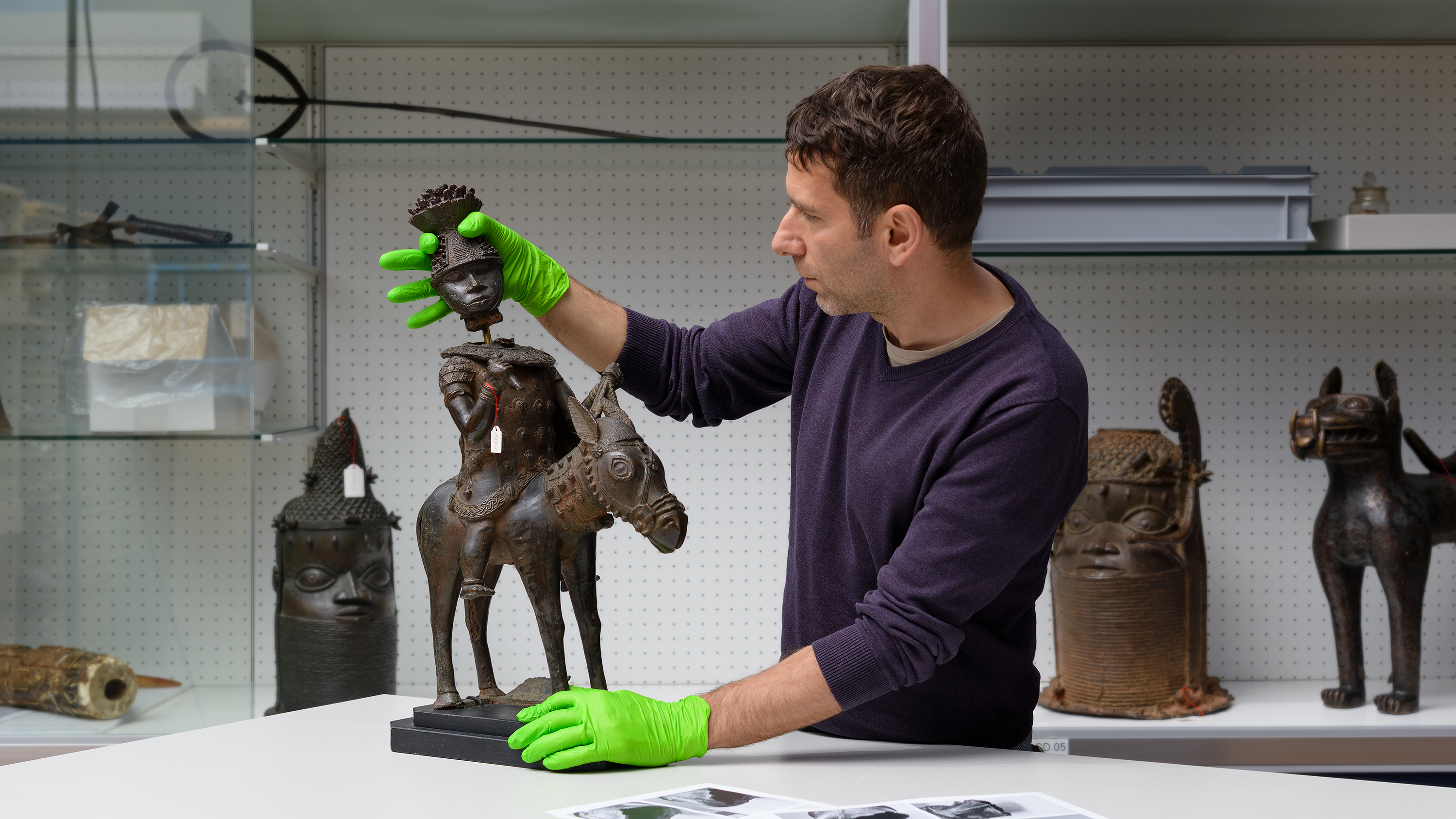
In 1897, British troops attacked the kingdom of Benin in present-day Nigeria. They ousted the king, burned down the capital and looted thousands of royal artefacts from the palace. In Europe, the objects were sold on the art market as "Benin Bronzes". In 1940, Benin artefacts also entered the collection of the Ethnographic Museum.
Today, these objects oblige us as a museum to engage with Nigerian communities, enable their access to their cultural heritage and acknowledge their claims to ownership.
This exhibition, drawing on research from the Swiss Benin Initiative (BIS), has been developed with Nigerian experts from Benin City and diaspora groups in Zurich.
Portrait Phil Omodamwen
The museum has commissioned the bronze caster Phil Omodamwen to recast one of the Benin artefacts for this exhibition. This is an opportunity for us to learn about bronze casting skills, Benin culture, and how acquisitions based on mutual consent can inform our work as a museum today.
Phil Omodamwen is a sixth generation bronze caster in Benin City who learned this skill from his father. His family belong to the Bronze-casting Guild Igun Eronmwon, who are responsible for producing royal objects. Today, however, the casters also work for the market and create new genres of objects and designs.
However, the production process is the same as in the past. The desired motif is modelled in wax over a clay core, and this mould is then covered with clay. The wax is melted out and the resulting cavity is filled with molten metal. The metal used today is often scrap metal.


